

 Deutsch

Clients often ask us whether we are a certified BICSI company – a legitimate question, because qualification certificates in the field of fiber optic and ITK infrastructure are crucial for contract awarding. The GRAEF Group has a TÜV certification. What at first glance seems like a gap is not one at all: Anyone who is familiar with the two certification models quickly recognizes that TÜV and BICSI speak the same language in terms of content – and that in the German and European market, the TÜV certification forms the more binding basis in many areas.
What is BICSI – and why do so many people know about it?
BICSI (Building Industry Consulting Service International) is a worldwide-active professional organization for ICT infrastructure founded in the USA. It awards certificates such as the RCDD (Registered Communications Distribution Designer) or the OSP (Outside Plant Designer) and has established itself primarily in North America, the Anglo-Saxon region and in globally operating companies as a benchmark of quality. BICSI certifications verify knowledge in the planning and installation of structured cabling, fiber optic networks and data center infrastructure based on internationally standardized curricula. In German public procurement tenders and in the European region, however, BICSI is not a legally mandated requirement – here, DIN-, VDE- and EN-standards as well as the certificates of nationally accredited testing bodies predominate.
How does the TÜV certification compare?
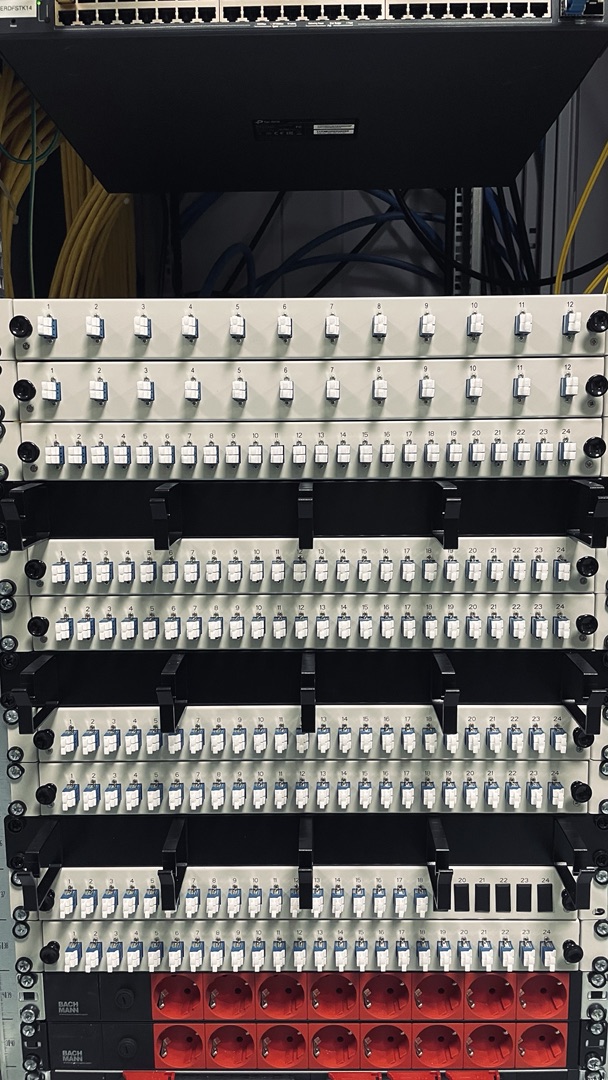
TÜV certifications for fiber optic technology and ITK infrastructure are issued by state-accredited German testing organizations (TÜV Rheinland, TÜV SÜD, TÜV Nord) and demonstrably confirm the practical and theoretical qualifications of technicians and companies. In content, they precisely cover the competencies that are also tested by BICSI: professional cable installation, splicing techniques, measurement technology, and documentation of completion according to recognized technical standards. The crucial difference lies in their legal weight: TÜV certifications are anchored in the German standard system, are directly recognized by authorities, network operators, and contracting parties such as Deutsche Bahn or the BVG, and are explicitly required in numerous performance specifications as proof of competence. The Professional splicing of optical waveguides For example, in Germany, almost always a TÜV-certified certificate is required for critical infrastructure projects – not necessarily an BICSI title.
Commonalities and differences at a glance
Both systems share the same goal: to ensure that individuals and companies working on active and passive ICT infrastructure possess proven, verified professional expertise. Both BICSI and TÜV assess theoretical knowledge of transmission standards, cable specifications and measurement technology, as well as the practical quality of implementation. Both require regular further training to maintain certification status. The essential difference lies in the geographic scope and reference framework: BICSI is based on ANSI/TIA standards and American standards; TÜV certifications are aligned with DIN EN, VDE and European regulations – that is, exactly those legal frameworks that apply in Germany for Fiber optic projects according to ZTV 48, For telecommunications networks and public construction projects, the TÜV certification is binding. For contractors in Germany and the EU, this means that the TÜV certification is not only equivalent, but in many cases even directly applicable, just like a BICSI certificate.
GRAEF Group: TÜV-certified, experienced and family-run
As a family-run company with over 15 years of experience in security and IT infrastructure, the GRAEF Group continuously invests in the qualification of its technicians. Our TÜV certification is not just a formality; it is a reflection of a commitment to quality that is reflected in every project – from planning to installation to OTDR acceptance. The measurement decline Following the bidirectional OTDR procedure, complete measurement protocols and documentation in accordance with the standards are an integral part of every delivery for us. If you have expected a BICSI reference from us and come across our TÜV certification: you receive the same level of quality – anchored in the German standards and legal system that directly applies to your projects in Germany and Europe.
Questions about qualifications? We are happy to advise you.
Whether it’s a request for tender, proof of qualification or technical clarification: the GRAEF Group is at your disposal for all questions regarding certification, fiber optic installation and IT infrastructure – nationwide, from a single source, with proven TÜV certification.
Does the GRAEF Group have a BICSI certification?
The GRAEF Group has a TÜV certification, but not a BICSI certificate. In terms of content, both systems cover the same areas of expertise – fiber optic installation, splicing technology, and measurement technology. In the German and European market, the TÜV certification is legally established and directly recognized by authorities, network operators, and public contracting authorities.
What is the difference between BICSI and TÜV?
BICSI is a US-based professional organization whose certificates are based on ANSI/TIA standards and are recognized internationally – especially in the Anglo-Saxon world. TÜV certifications are based on DIN, VDE and EN standards and are legally established in Germany and the EU. For projects in Germany, the TÜV certification is therefore often the more direct and binding basis for qualification.
Are TÜV and BICSI equivalent?
Yes, both systems assess comparable competencies in terms of content: cable specifications, installation technology, splicing quality and measurement technology. The difference lies in the reference framework: BICSI refers to American standards, while TÜV to European ones. In the German market, the TÜV certification often has greater legal weight due to its normative anchoring in the market.
Which certification is relevant for fiber optic projects in Germany?
For projects in Germany, TÜV certifications as well as certificates according to ZTV 48, ZTV-TKNetz 48 and DIN VDE are the relevant qualification certificates. BICSI certificates are not a legally required standard in German performance specifications; however, TÜV certifications are explicitly required by numerous public and private sector clients.
Can I hire GRAEF Group for projects that require a BICSI qualification?
As a rule, yes. Most clients who cite BICSI as a reference are looking for proof of proven technical expertise in IT infrastructure. This expertise is demonstrated by the GRAEF Group through its TÜV certification – based on the standards framework applicable in Germany and the EU. We recommend that, in case of doubt, you jointly verify whether the respective client refers to BICSI as a mandatory requirement or merely as a guiding criterion.

Contributions from the practical experience of our installers, project managers and software developers. The group is led by founder Peter Gräf, a DGuSV-certified expert in security technology.
Our team



 German
 English