

 Deutsch
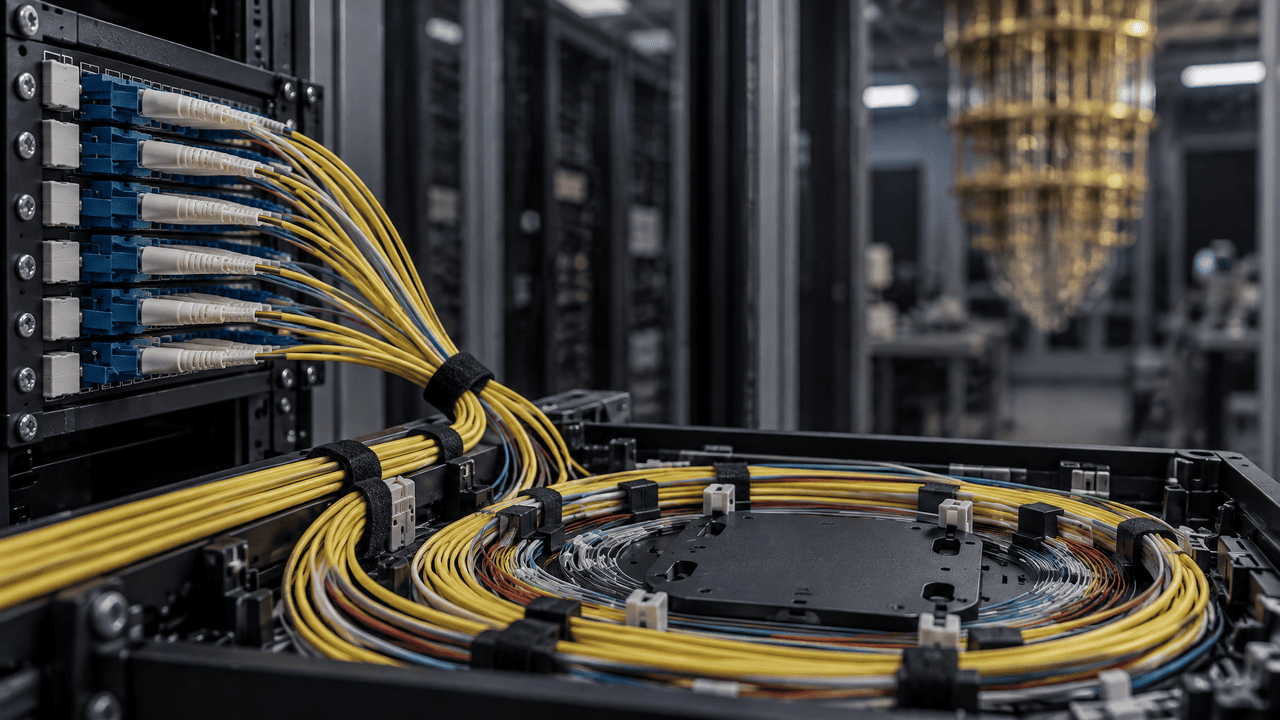
Quantum computers, quantum sensors, and secure quantum communication are considered key technologies of the coming decades. For these systems to reach their full potential, they must be interconnected – and the medium for this is primarily fiber optic cables. Anyone who plans and installs fiber optic cables today is creating the foundation for the quantum information networks of the future.
Why quantum computing relies on fiber optics
A single quantum computer is already capable of performing complex calculations, but its true potential is unlocked through networking. By connecting multiple quantum processors, the computing power can be increased, remote quantum computers can be made accessible to users in other locations, and spatially distributed quantum sensors can combine their measurement data. All of this requires that quantum information travels reliably from one node to the next.
This information is transmitted using individual photons, that is, light particles. This is the difference to classical data transmission: A quantum state cannot be simply copied or amplified. Every photon that is lost due to attenuation, poor connections or dirty connectors along the way is lost. The quality of the fiber section therefore directly determines how far and how reliably quantum communication works. Proper technical Lightwave cable assembly This therefore becomes a prerequisite for any quantum application.
Direct link to the quantum repeater
Quantum information networks are gradually developing. In the beginning, there are short, direct connections, such as between quantum processors in the same location or between two buildings within a city. Larger distances can now be bridged using so-called trusted nodes – trusted intermediate stations where the information is, however, temporarily stored in a classical way.
The goal of the research is the quantum repeater. It interlinks two quantum memories using the entanglement swapping method via a third, central storage device, bridging distances without requiring the quantum state to be read. Experts refer to this as a marathon: Many intermediate steps are necessary; the transfer from science to industry is still in its infancy. However, there is agreement on one point: without a consistent expansion of the infrastructure, there will be no scaled-up quantum networks. Precise Fiber-optic splicing according to ZTV 48 With minimal damping per connection, it is a crucial component for this.
- Short direct quantum links within a location or a city
- Quantum communication over trusted nodes
- Quantum repeaters for long distances without trusted intermediate stations
- Scaled quantum information networks that connect quantum computers and quantum sensors
Quantum communication as a security factor
In addition to computing power, security plays a central role. Powerful quantum computers could in the future break certain encryption methods currently in use. Already now, there is the risk of „Harvest Now, Decrypt Later“: attackers store encrypted data today in order to decrypt it later. Post-quantum cryptography is therefore considered an indispensable first step that companies and authorities should implement promptly.
In addition, quantum key exchange (QKD) offers physically based security between two nodes, because any eavesdropping attempt changes the quantum state and is detected. At the European level, the EuroQCI initiative is driving the development of such infrastructure. For operators of critical infrastructure, this means that physical network infrastructure and IT security must be considered together. Our cybersecurity advisory services help you prepare your systems for the time after the so-called Q-Day.
Planning fiber optic networks for the future
Anyone building new Wavelength Division Line (WDL) networks today should plan for sufficient fiber reserves, rely on single-mode fibers with low attenuation, and document every section of the network using OTDR measurement to ensure complete coverage. This allows individual fibers to be used for quantum applications later without the need to build new ones.
GRAEF Group: Fiber optic infrastructure with a view to the quantum future
The GRAEF Group plans, installs, and maintains fiber optic networks for companies, data centers, research institutions, and the public sector throughout Germany. Since 2007, as a family-run company, we have been supporting our customers from initial consultation through route planning, the insertion and laying of the cables, splicing, and the measurement and acceptance of the results, to long-term maintenance. Our technicians work according to recognized standards and document each route in a traceable manner.
Especially in projects involving quantum computing and quantum communication, every tenth of a decibel counts. Clean splices, tested connectors, and a thoughtful fiber reserve make the difference between a network that only meets today's requirements and an infrastructure that supports the technologies of tomorrow. Contact us – together we will prepare your fiber optic network for the quantum future.
Why is fiber optic for quantum computing so important?
Quantum computers and quantum sensors only reach their full potential when they are interconnected. Quantum information is transmitted using individual photons, and the optical fiber is the most important medium for this transmission over longer distances.
Can I prepare my existing fiber optic network for quantum applications?
Yes. With sufficient fiber reserves, loss-free single-mode fibers, precise splicing, and complete OTDR documentation, networks can be designed so that individual fibers can later be used for quantum applications.
Does GRAEF offer fiber optic installation nationwide?
Yes. The GRAEF Group plans, installs and maintains fiber optic networks throughout Germany, from consulting to installation, splicing and measurement, and long-term support.
Contributions from the practical experience of our installers, project managers and software developers. The group is led by founder Peter Gräf, a DGuSV-certified expert in security technology.
Our team



 German
 English