

 Deutsch
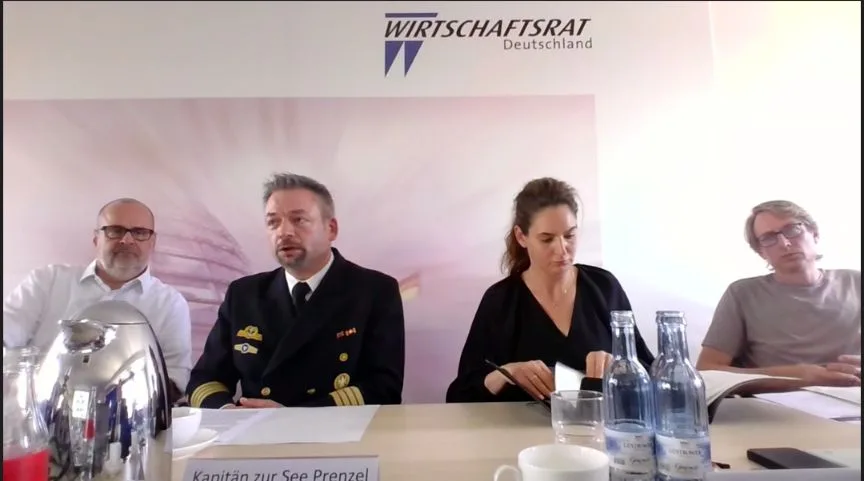
On Tuesday, September 8, 2026, Peter Gräf, Director and Founder of the GRAEF Group, participated in a special online conference on the future of quantum communication. The joint meeting of the Federal Expert Commission on Cybersecurity and the Federal Working Group on Space was titled „Quantum communication as a strategic infrastructure for Germany and Europe – How space and cybersecurity strengthen our technological sovereignty“.
The event brought together perspectives from cybersecurity, space, research, and security policy. The focus was on the question of what technological and political prerequisites need to be created so that quantum communication can be developed into a secure, resilient, and strategically important infrastructure for Germany and Europe.
Quantum communication is gaining strategic importance
Quantum communication is no longer just a topic of basic research. The development of this technology touches upon key issues of digital sovereignty, the protection of critical infrastructure, and Europe’s long-term competitiveness. Secure communication channels are essential for government agencies, companies, research organizations, and operators of critical infrastructure.
With the increasing interconnectedness of energy supply, transport, healthcare, administration, industry, and telecommunications, the requirements for the security of digital communication are also increasing. Data must not only be transmitted quickly and reliably; it must also be protected from unauthorized access and targeted manipulation.
Quantum communication is considered a potential component of future security architectures in this context. Its development is closely linked to modern cryptography, powerful communication networks, satellite technology, and the protection of digital systems.
Technological sovereignty as a shared task
Technological sovereignty means that Germany and Europe have sufficient competencies, infrastructure, and development opportunities to independently assess, deploy, and develop security-relevant technologies. This includes research funding, qualified professionals, secure supply chains, and close collaboration between politics, science, and business.
Especially for strategic technologies, it is important to think long-term. Research projects, industrial applications, and political frameworks must be coordinated with each other. Only in this way can scientific findings be converted into a reliable infrastructure that is also capable of meeting the requirements of future crises and threat scenarios.
Cybersecurity and space exploration considered together
The joint meeting deliberately focused on the connection between two areas that are of great importance for Europe’s digital future: cybersecurity and space. Satellite-based communication systems can play an important role in connecting far-flung locations and securing redundant communication routes.
At the same time, spacecraft systems themselves must be protected against cyberattacks, disruptions, and manipulation. This applies to satellites, ground stations, control systems, and the transmitted data. A secure communication infrastructure must therefore be planned holistically and must not be limited solely to individual technical components.
The discussion about quantum communication also illustrates that security issues increasingly extend beyond individual buildings or networks. Protection concepts must connect the physical, digital, and organizational levels together. A professional Planning of security concepts Therefore, it takes into account not only existing risks, but also future technological developments.
Inspiration from politics, research and the German Armed Forces
The announced sponsors included Florian Müller MP, member of the Committee on Research, Technology, Space and the Assessment of Technology Consequences of the CDU/CSU parliamentary group, Dr. Alexandra-Gwyn Paetz, Head of the Department of Technological Sovereignty and Innovation at the Federal Ministry of Research, Technology and Space, and Vice Admiral Dr. Thomas Daum, Inspector of the Cyber and Information Space of the German Armed Forces.
The different professional perspectives made it clear that quantum communication cannot be viewed in isolation. Research and development, national security interests, military leadership capabilities, and economic competitiveness are closely intertwined.
Why such issues are important for companies
Companies that are not directly involved in the development of quantum communication are also affected by the changes in the digital security landscape. New technologies, stricter requirements for data protection, and the increasing interconnection of systems all require flexible and forward-looking security concepts.
GRAEF Group: Future-oriented security in focus
Peter Gräf’s participation in the online conference underscores the GRAEF Group’s interest in technological and security-related developments. As a company in the security technology sector, we are closely monitoring how requirements for the protection of buildings, systems, communication routes, and critical infrastructure are changing.
Modern security is created through the interaction of various systems. Intrusion detection technology, access control, video surveillance, secure alarm transmission, and digital management processes must be intelligently coordinated with each other. Video surveillance For example, not only image quality and storage capacity play a role. Network connections, access rights, data protection, and integration into existing security processes are also crucial.
The GRAEF Group not only wants to observe developments, but also to understand their significance for practical safety planning. Our goal is to provide customers with competent guidance and develop solutions that meet both today’s requirements and the changes that will occur in the years to come.
Conclusion
The online conference on quantum communication focused on the importance of safer and more resilient communication infrastructures for Germany and Europe. The connection between cybersecurity, spaceflight, research, and security policy shows that technological sovereignty can only be achieved through joint efforts.
With the participation of Peter Gräf, the GRAEF Group reaffirms its commitment to actively following technological developments and focusing on the future of security. Because anyone who wants to protect infrastructure sustainably must not only be aware of today’s risks but also understand the technologies that will shape the security landscape tomorrow.
Other topics that might interest you
- Security technology for companies and institutions
- Ajax radio alarm systems for modern security solutions
- Ajax Hubs for connected security
- Security technology for outdoor areas
Contributions from the practical experience of our installers, project managers and software developers. The group is led by founder Peter Gräf, a DGuSV-certified expert in security technology.
Our team


 German
 English