

 Deutsch

Cybersecurity is no longer solely the responsibility of the IT department. It affects companies, public institutions, municipalities, critical infrastructure, and society as a whole. With increasing digitalization, the demands on secure communication channels, reliable processes, protected data, and action-ready organizations are also growing. The Federal Expert Commission on Cybersecurity will address these strategic issues in Berlin on October 20, 2026.
The focus of the meeting is the question of how Germany can play its role as a Cybernation Strengthen geopolitical competition and shape the path from overarching strategies to concrete implementation. The agenda combines perspectives from research, politics, municipal practice, and the business sector. This brings a topic into focus that goes far beyond individual technical measures: cyber resilience must be planned, implemented, and continuously developed at all levels.
Cybersecurity as a strategic task for Germany
The digital transformation is changing the way companies, authorities, and operators of critical infrastructure work. Processes are becoming interconnected, data is available across locations, and more and more systems are communicating with each other. This development creates opportunities for efficiency, innovation, and new business models. At the same time, it expands the attack surface for cyberattacks, manipulation, outages, and unauthorized access.
The first agenda item of the meeting therefore poses the strategic question: What must Germany rethink in its geopolitical competition? Dr. Alexandra Paulus, head of the research cluster Cyber Security and Digital Policy at the Stiftung Wissenschaft und Politik, will provide impulses on this topic. At its core, it concerns the connection between security interests, technological capabilities, and digital sovereignty.
Digital sovereignty does not mean having to develop every technology ourselves or operate it in complete isolation. Rather, it involves the ability to understand risks, consciously manage dependencies, and remain operationally capable in the event of critical systems failure. For companies, this means, among other things, that security decisions should not only be made in the short term but be part of a long-term, sustainable strategy.
Resilience begins with a realistic picture of the situation
Cyber resilience describes the ability to detect attacks and disruptions as early as possible, limit their impact, and restore operations. This includes technical protective measures as well as clear responsibilities, documented processes, and regular reviews. A security plan must therefore not only take into account normal operations but also answer the question of what happens in the event of an incident.
In practice, this applies to many areas simultaneously: the security of IT systems, the protection of access points, the monitoring of critical building areas, secure communication, and collaboration between internal stakeholders and external service providers. Security measures are most effective when they are planned in a coordinated manner and interrelate in a comprehensible way.
Digital location: Innovation, AI and sovereignty
The second agenda item focuses on Germany’s digital landscape. Marvin Schulz MP, member of the Committee on Digital and State Modernization, will discuss innovation, artificial intelligence, and digital sovereignty. These topics are closely intertwined: AI can speed up processes and support security teams in evaluating large amounts of data. At the same time, the requirements for data privacy, data quality, system integrity, and responsible use are increasing.
This creates concrete tasks for the security industry. Modern security technology can now structurally capture access events, alarm notifications, and video data. Intelligent features help better categorize relevant events. However, the technology remains only a component of a functioning overall concept. It is crucial that systems are selected appropriately, properly configured, and operated by trained personnel.
- Identify risks, dependencies, and critical processes early on
- Plan technical and organizational protection measures together
- Clearly structure access points, data, and security-relevant building areas
- Define alarm and escalation processes in a comprehensible way
- Regularly review security concepts and adapt them to new requirements
It is particularly evident at the interfaces between digital and physical security how important a holistic approach is. An inadequately protected door, unclear access control or an unattended technical area can be just as much a part of a security risk as a vulnerability in the network. The GRAEF Group supports the planning of Security technology for individual object requirements.
Cyber resilience is also determined on the ground
The third agenda item is titled „Federal Implementation – Cyber Resilience is Decided Locally.“ Dr. Kay Ruge, Executive Vice President and Chief Executive Officer of the German Landkreistag, thus illuminates the practical level of implementation. Strategies can only become effective if they are translated into concrete processes in cities, counties, companies, and institutions.
On-site, abstract security goals meet real-world conditions: different building structures, limited resources, historically evolved technology, and individual operating procedures. Therefore, there is no universal one-size-fits-all solution for all objects. A thorough inventory is required, from which priorities and appropriate measures can be derived.
For buildings and corporate locations, this may mean, for example, reviewing existing systems, dividing access according to protection needs, and specifically securing security-relevant areas. Video surveillance, access control, intrusion detection technology, and organizational processes should not be considered separately. It is only their interplay that creates a reliable security architecture.
Strategy needs actionable steps
Cyber resilience does not arise solely from policies or individual products. It grows through clear responsibilities, audited processes, appropriate technology, and a willingness to continuously develop security measures.
Five priorities for Germany's cybernation
The final stage of the technical consultation is the joint discussion of the position paper „From Strategy to Implementation – 5 Priorities for Germany’s Cybernation“. This part is moderated by Katharina M. Schwarz, deputy chair of the Federal Expert Commission on Cybersecurity and Head of Digital Sovereignty at Myra Security.
The consultation of such a position paper underscores the need to translate strategic goals into tangible priorities. This involves not only technological developments, but also framework conditions for innovation, competencies, collaboration, and the resilience of organizations. Germany needs a security culture that takes digital risks seriously while simultaneously enabling progress.
For those responsible in companies, the debate offers an important impetus: security planning should not begin only when an incident has occurred. A proactive approach to buildings, processes, and digital systems creates the foundation for better managing risks. In developing appropriate solutions, the GRAEF Group supports its customers from analysis to implementation. Further information can be found in the section Planning and advising on security technology.
More information
- GRAEF Group: Security technology and individual solutions
- GRAEF Alarm Systems Berlin
- Security technology in the GRAEF Group online shop

Contributions from the practical experience of our installers, project managers and software developers. The group is led by founder Peter Gräf, a DGuSV-certified expert in security technology.
Our team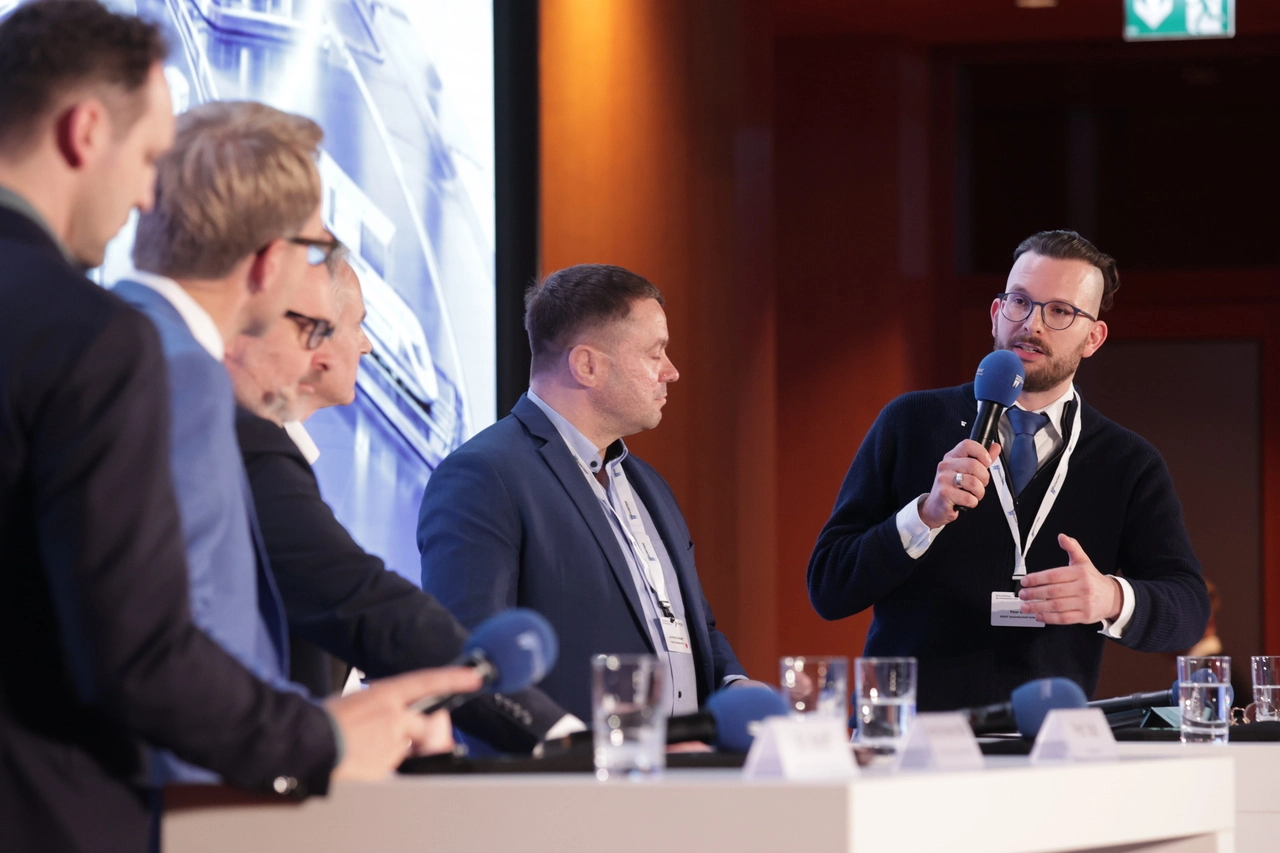



 German
 English