
Introduction to fiber optic cables: basics and innovative applications

The world of telecommunications has developed rapidly in recent decades. A key technology that has driven this development is the fiber optic cable. In this article, we will introduce the basics of fiber optic cables and their innovative applications.
What are fiber optic cables?
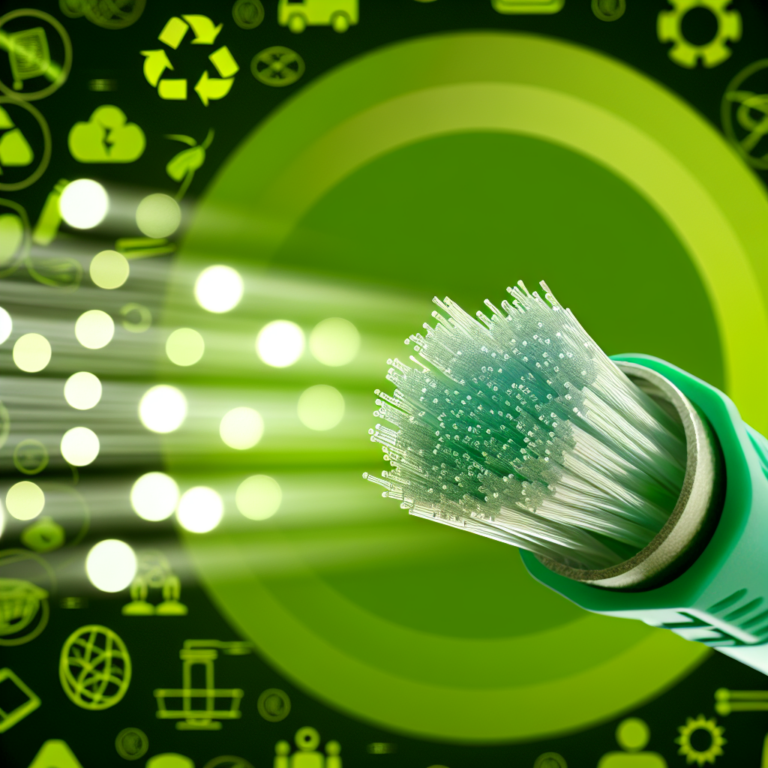
Fiber optic cables, also known as fiber optic cables, are a type of cable that uses light to transmit information. They consist of a core surrounded by a sheath. The core conducts the light, while the cladding holds the light in the core. Fiber optic cables have a number of advantages over conventional copper cables, including higher bandwidth, lower attenuation and greater immunity to electromagnetic interference.
How do fiber optic cables work?
The functioning of fiber optic cables is based on the principle of total internal reflection. When light from a medium with a high refractive index (such as the core of the cable) hits a medium with a low refractive index (such as the sheath), it is completely reflected if the angle of incidence is large enough. In this way, the light can be transmitted over long distances without significant losses.
Innovative applications for fiber optic cables
Fiber optic cables have a variety of applications that go far beyond telecommunications. Here are a few examples:
- Medicine: In medicine, fiber optic cables are used to carry out endoscopic examinations. They enable doctors to obtain images from inside the body without having to carry out invasive procedures.
- Military: In the military sector, fiber optic cables are used for the secure transmission of information. They are immune to electromagnetic interference that could otherwise disrupt electronic communication systems.
- Energy: In the energy sector, fiber optic cables are used to monitor high-voltage lines. They can carry out temperature and strain measurements in order to detect potential problems at an early stage.
The future of fiber optic cables
The future of fiber optic cables looks very promising. With increasing digitalization and the growing need for fast and reliable data connections, the demand for fibre optic cables is expected to continue to rise. In addition, ongoing research and development work is likely to lead to even more powerful and versatile fiber optic cables.
Fiber optic cable: A key to the digital future
In summary, fiber optic cables play a crucial role in shaping our digital future. Not only do they offer superior performance compared to conventional copper cables, but they also open up a wealth of new and innovative applications. Whether in medicine, the military or the energy sector - the possibilities for the use of fiber optic cables are virtually unlimited.