
Kosten LWL Spleißen: So planen Sie Ihr Glasfaserprojekt

Die Planung eines Glasfaserprojekts kann eine herausfordernde, aber lohnenswerte Aufgabe sein. Dabei spielt das Spleißen von Lichtwellenleitern (LWL) eine zentrale Rolle. Die Kosten für das Spleißen von LWL sind ein bedeutender Faktor bei der Budgetierung. Um sicherzustellen, dass Ihr Glasfaserprojekt reibungslos verläuft, ist es wichtig, die verschiedenen Aspekte der Kosten zu verstehen und zu planen. In diesem Artikel beleuchten wir die wichtigsten Elemente beim Spleißen von LWL und wie Sie die Kosten effektiv managen können.
Hinweis zu AI-generierten Inhalten: Die Inhalte dieses Blogs werden mithilfe fortschrittlicher künstlicher Intelligenz erstellt. Obwohl wir uns bemühen, Ihnen stets präzise und nützliche Informationen zu bieten, kann es vorkommen, dass Fragen oder Unklarheiten bestehen bleiben. In solchen Fällen stehen Ihnen unsere Experten gerne zur Verfügung. Zögern Sie nicht, uns über die unten aufgeführten Kontaktmöglichkeiten zu erreichen. Unsere Spezialisten sind wahre Kenner ihres Fachs und helfen Ihnen gerne weiter!

Kontaktmöglichkeiten:

Feedback-Formular: Formular Ausfüllen
E-Mail: vertrieb@graef-gruppe.de
Telefon: +493069202294
Wir freuen uns auf Ihre Rückfragen und darauf, Ihnen bei jedem Anliegen behilflich zu sein!
Kosten LWL Spleißen: Einflussfaktoren verstehen
Bevor Sie mit Ihrem Glasfaserprojekt beginnen, sollten Sie wissen, welche Faktoren die Spleißkosten beeinflussen. Dabei sind die folgenden Punkte entscheidend:
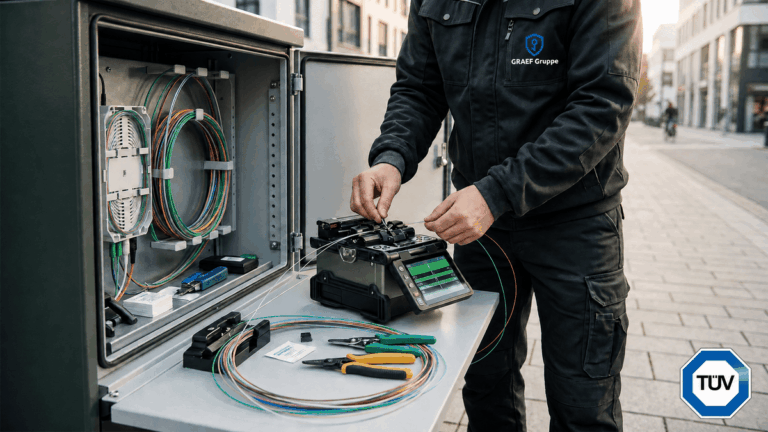
- Technologie: Moderne Spleißgeräte, wie Fusionsspleißgeräte, bieten präzises Arbeiten, doch ihr Einsatz kann teuer sein.
- Materialkosten: Die Qualität der Glasfaserkabel und der notwendige Zubehör können die Kosten erheblich beeinflussen.
- Arbeitskraft: Qualifizierte Techniker sind entscheidend für eine erfolgreiche Umsetzung, ihre Löhne müssen berücksichtigt werden.
Ein Beispiel: Bei einem Projekt in Bayern konnten durch den Einsatz moderner Fusionsspleißgeräte die Ausfallzeiten um 30% reduziert und somit langfristig Kosten gespart werden.
Planen Sie Ihr Budget sorgfältig
Erstellen Sie einen detaillierten Finanzplan
Eine gründliche Budgetierung ist unerlässlich. Sie sollten alle potenziellen Kosten in Betracht ziehen, um Überraschungen zu vermeiden.
- Projektumfang: Definieren Sie den Umfang klar, um präzise Kostenschätzungen zu erhalten.
- Angebotseinholung: Holen Sie sich Angebote von verschiedenen Anbietern ein, um die besten Preise zu sichern.
- Unvorhergesehene Ausgaben: Planen Sie 10-15% extra für unvorhergesehene Kosten ein.
Ein Fallbeispiel aus Hessen zeigt, dass durch detaillierte Planung und Angebotseinholung die Projektausgaben um 20% gesenkt werden konnten.
Setzen Sie auf Qualität statt kurzfristige Einsparungen
Es kann verlockend sein, an der Qualität zu sparen, doch langfristig zahlt sich eine Investition in hochwertige Materialien und Fachkräfte aus.
- Langfristige Einsparungen: Höhere Anfangsinvestitionen können zukünftige Reparaturkosten minimieren.
- Projektdauer: Ein gut geplantes und qualitativ hochwertiges Projekt hat eine längere Lebensdauer.
Kosten LWL Spleißen: Effektives Projektmanagement
Koordination und Überwachung
Ein erfolgreiches Glasfaserprojekt erfordert eine sorgfältige Koordination und Überwachung.
- Projektmanager: Ernennen Sie einen erfahrenen Projektmanager, der den Überblick behält.
- Fortschrittsberichte: Regelmäßige Berichterstattung hilft, den Zeitrahmen und das Budget im Auge zu behalten.
- Risikomanagement: Identifizieren Sie potenzielle Risiken frühzeitig und planen Sie entsprechende Maßnahmen ein.
Eine Studie in Hamburg belegt, dass gut koordiniertes Projektmanagement die Effizienz um 40% steigern kann.
Insgesamt ist die Planung eines Glasfaserprojekts mit zahlreichen Überlegungen verbunden, insbesondere wenn es um die Kosten für das Spleißen von LWL geht. Durch das Verständnis der Einflussfaktoren, sorgfältige Budgetierung und effektives Projektmanagement kann Ihr Glasfaserprojekt erfolgreich und kosteneffizient umgesetzt werden. Investieren Sie in Qualität und Expertise, um langfristig von stabilen und leistungsfähigen Netzwerken zu profitieren.